
Prosperity Market
Impact Study.
A system-level UX evaluation under constraint
This Impact Study examined Prosperity Market’s live digital marketplace as a system—identifying where structural friction affected usability, trust, and revenue across shoppers, vendors, and supporters.

By focusing on content structure, user flows, accessibility, and funnel behavior, the work clarified how targeted, incremental changes could reduce risk without disrupting an already-operational ecosystem.
PRJ – 002, Operational Impact, +/– Quantified
Metrics reflect observed behavior, diagnostic system analysis, and modeled opportunity from internal flow logic.
System Friction, Clarity Gap, & Unrealized Value
56% cart abandonment identified at key checkout points
Observed behavioral signal (− impact)
Competing user journeys converging on objectives Diagnostic system finding (– impact)Small gains in flow clarity doubling monthly revenues Modeled opportunity from reduced friction (+ impact)
CONTEXT & CONSTRAINTS
A live, revenue-generating platform required system-level intervention rather than UI overhaul.
Prosperity Market operates at the intersection of nonprofit mission and ecommerce execution, supporting Black farmers and small food producers while relying on a live, revenue-generating digital marketplace to sustain operations. At the time of engagement, the platform served active vendors, shoppers, and supporters—meaning any disruption risked harming the ecosystem it was meant to support.
Within this context, the engagement was intentionally scoped as a strategic UX intervention rather than a rebuild. The work focused on how the existing system behaved, where it created friction for different user groups, and how future decisions could be made with greater clarity.
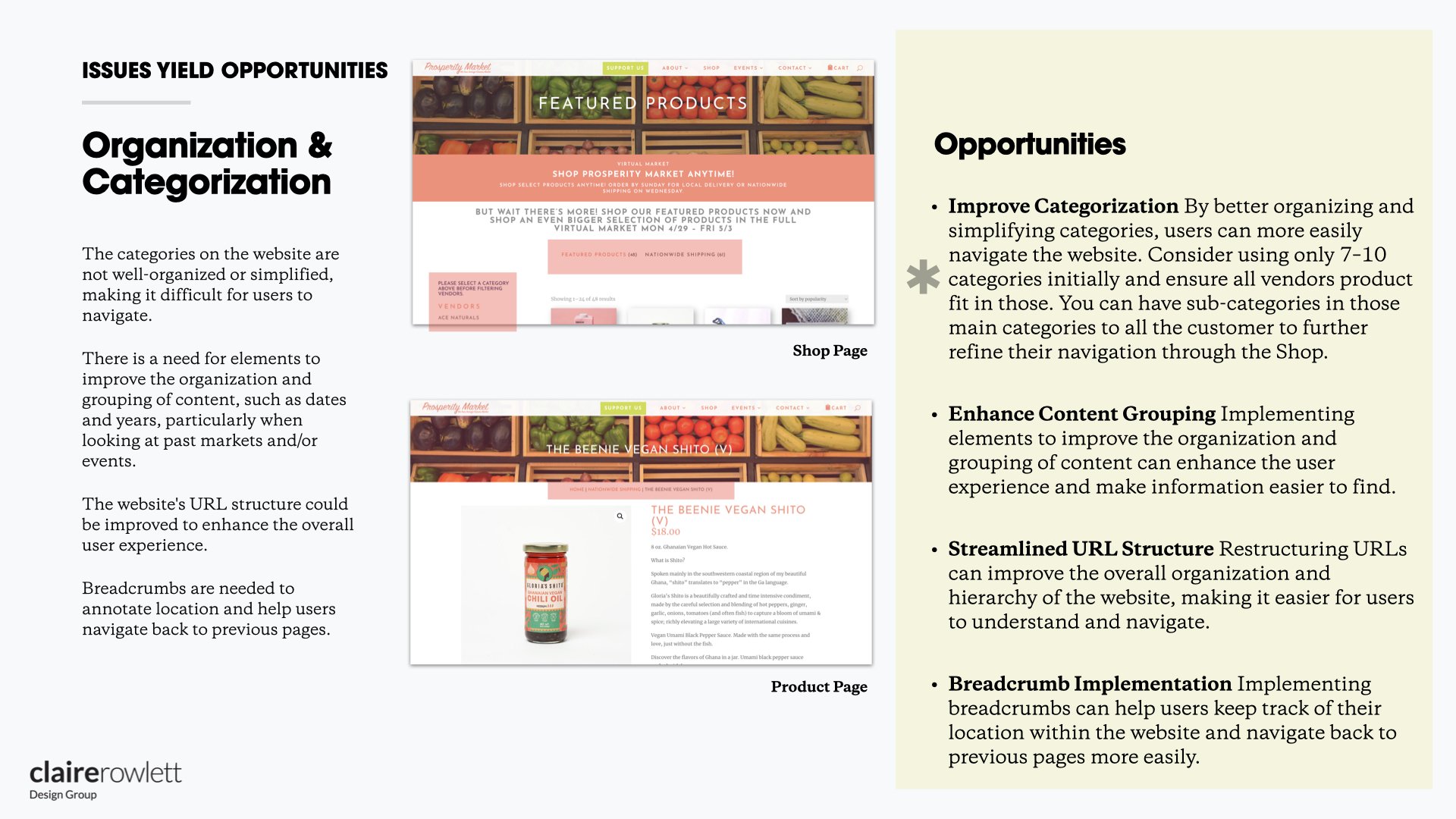
THE SYSTEM, NOT THE SCREENS
Why This Wasn’t a Redesign
Although initially framed as a “website reimagine,” the agreed scope excluded visual redesign, taxonomy rebuilds, new imagery, or development implementation. Budget, timing, and platform dependencies made a full redesign unrealistic—and potentially risky—for an already operational marketplace.
Instead, the work treated the site and its surrounding operations as a system. This system lens became visible not in abstract theory, but in how checkout, content structure, and revenue flows behaved. The focus was to:
Make the current experience legible across audiences through a structured audit
Identify where UX breakdowns were rooted in content, structure, or process—not just interface
Produce guidance that could support incremental change over time, regardless of who executed it
This distinction matters. The goal was not to make the site look different, but to make the system understandable—to the internal team, to vendors, and to shoppers.
USER ECOSYSTEM MAPPING
Three Users, One Shared Infrastructure
Prosperity Market serves three distinct audiences, each with different goals but a shared dependency on the same digital infrastructure:
Virtual Market Consumers
Online shoppers navigating product discovery, category clarity, shipping rules, and checkout while attempting to support values-aligned vendors within limited time and attention.Vendors / Potential Vendors
Small, often under-resourced producers relying on clear onboarding, category placement, and accessible information to participate effectively in the marketplace.Donors / Supporters / Partners
Mission-driven stakeholders seeking credibility, transparency, and clear pathways to contribute—financially or otherwise—through a site that frequently tried to address too many audiences at once.
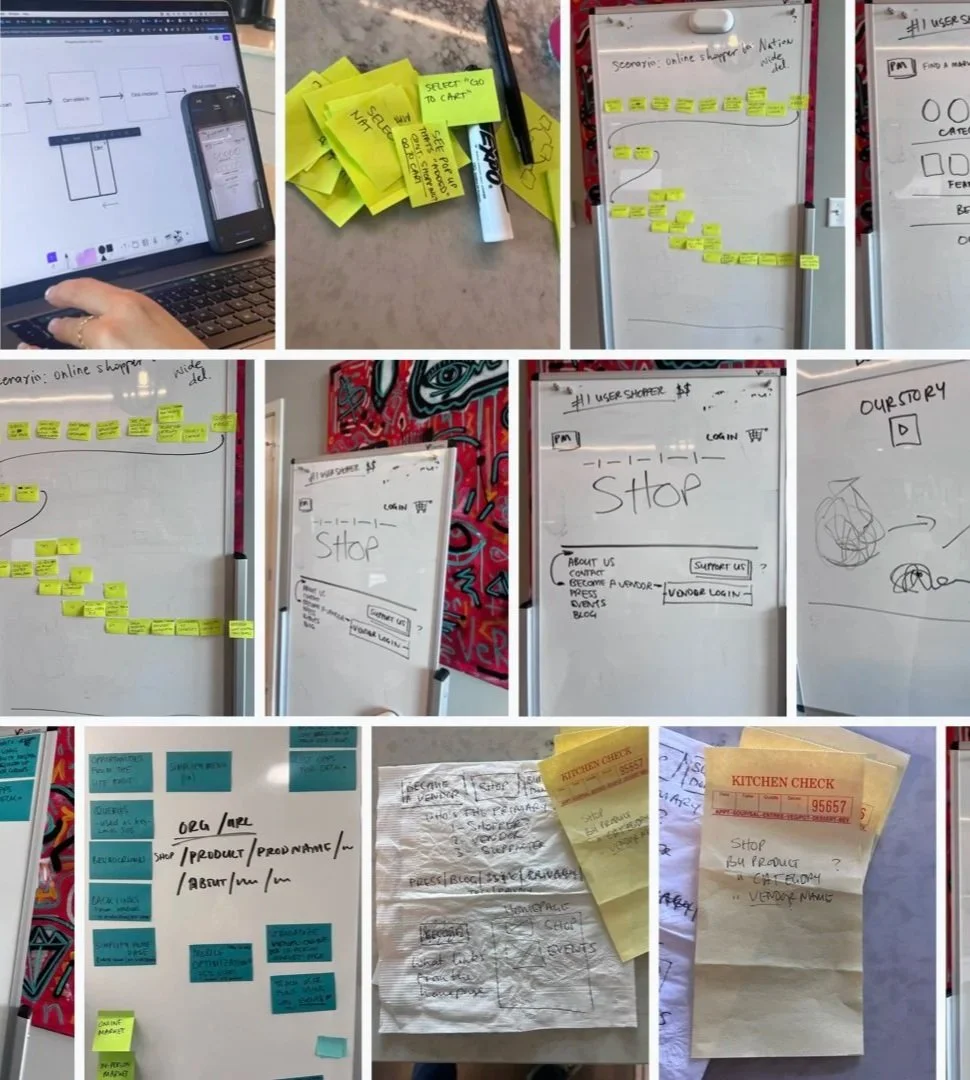
Mapping these users revealed a core structural tension: optimizations for one audience often introduced friction for another. Pages designed to “speak to everyone” diluted priority, leaving no single user clearly served. Any durable recommendation therefore had to acknowledge these tradeoffs and balance competing needs rather than privileging a single path. This tension surfaced repeatedly in checkout flows, content structure, and revenue pathways.SIGNAL vs NOISE
Content Inventory as a Decision Tool
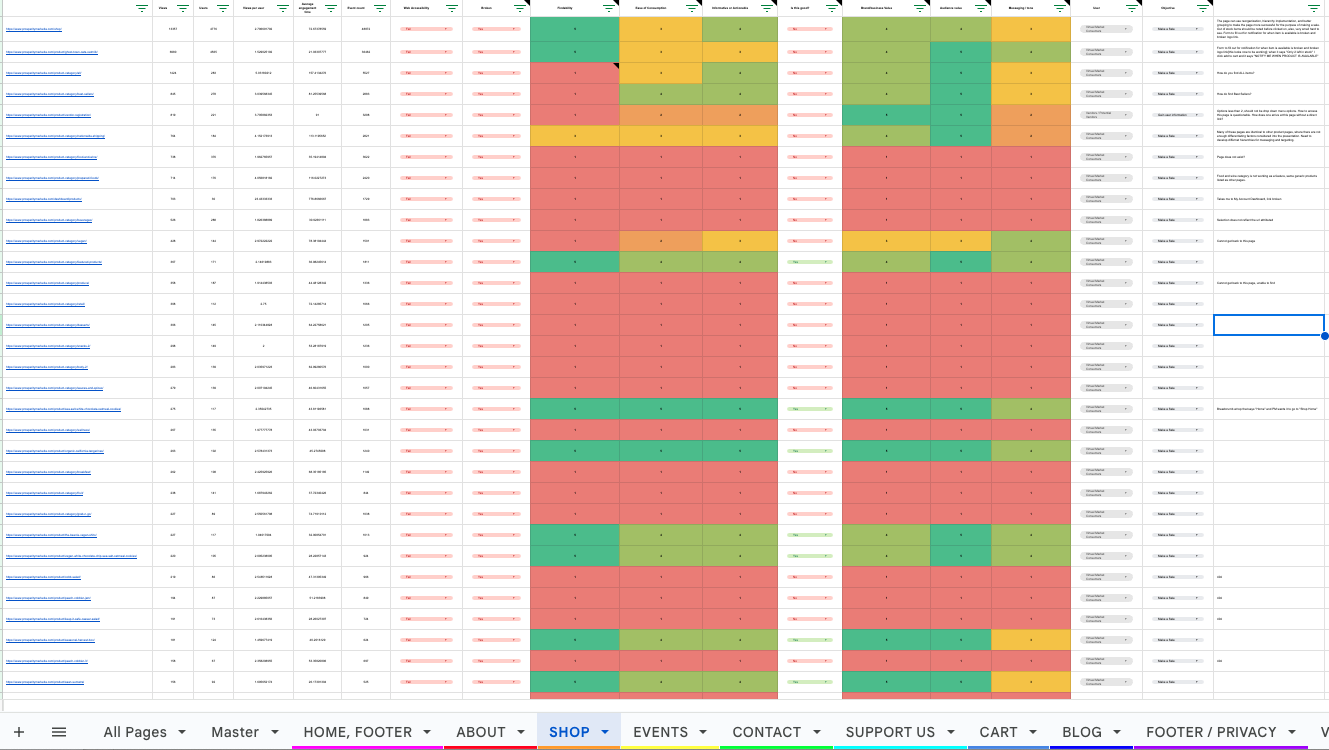
A full content inventory and site audit formed the analytical backbone of the engagement. Rather than treating content as static copy, the audit surfaced patterns of duplication, decay, and misalignment that directly affected usability and trust.
Across the site, the audit revealed:
Broken product links, missing inventory pages, and recurring 404 states that disrupted high-intent navigation and undermined trust
Pages carrying multiple agendas with no clear primary purpose
Inconsistent naming, overlapping pages, and repeated content blocks that diluted key messages
Broken links, missing media, and non-functioning components that disrupted user flows and eroded credibility
The inventory shifted from a static catalog of pages into a decision tool—making visible where content supported the mission, where it introduced friction, and where it actively worked against user understanding. This reframing allowed content decisions to be evaluated systemically, not aesthetically.
Friction Revealed Through Flows
Using the audited content as input, user flows were developed for each primary audience—online shoppers, vendors, and supporters—and reviewed against observed funnel behavior and drop-off patterns. These flows traced real paths through the system, from entry points to checkout, onboarding, and contribution.
Several structural failure patterns emerged:
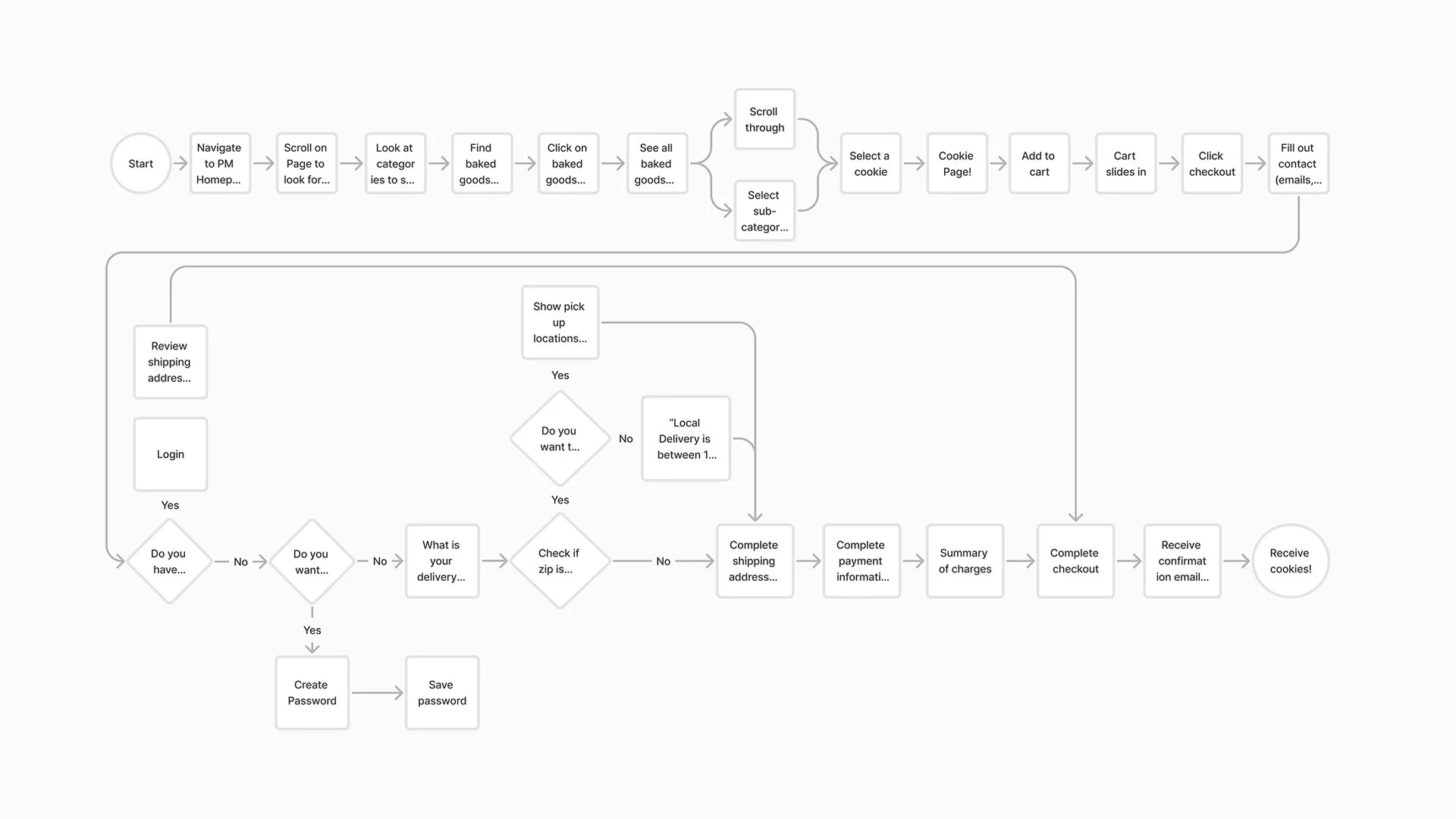
Online Shopper User Flow
Checkout journeys were long, visually dense, and unclear about shipping rules, contributing to a 56% cart abandonment rate during the review period.
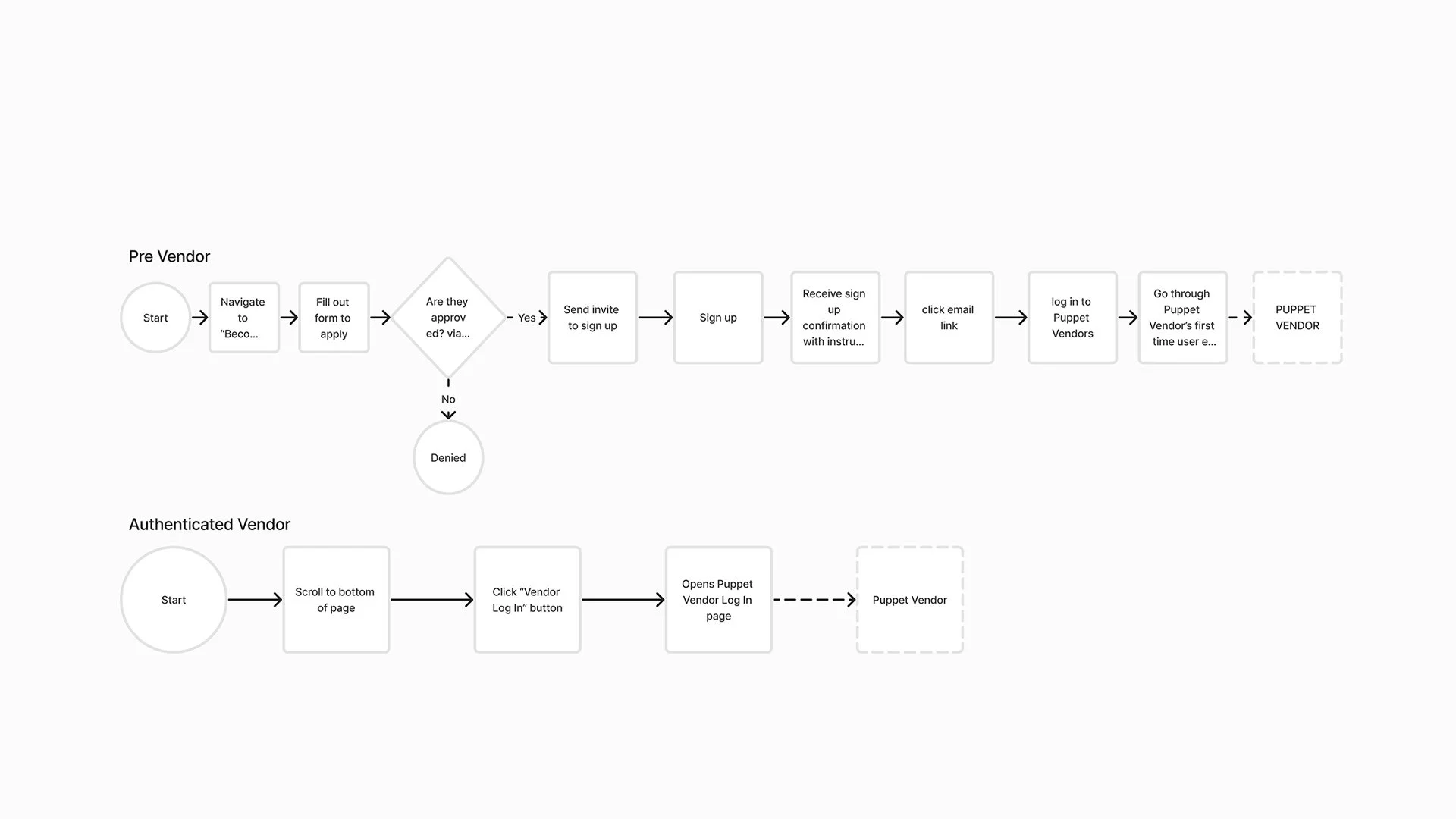
Vendor User Flow
Product discovery was undermined by inconsistent category structures, template variation, and missing navigational cues, forcing users to rely on guesswork and backtracking.
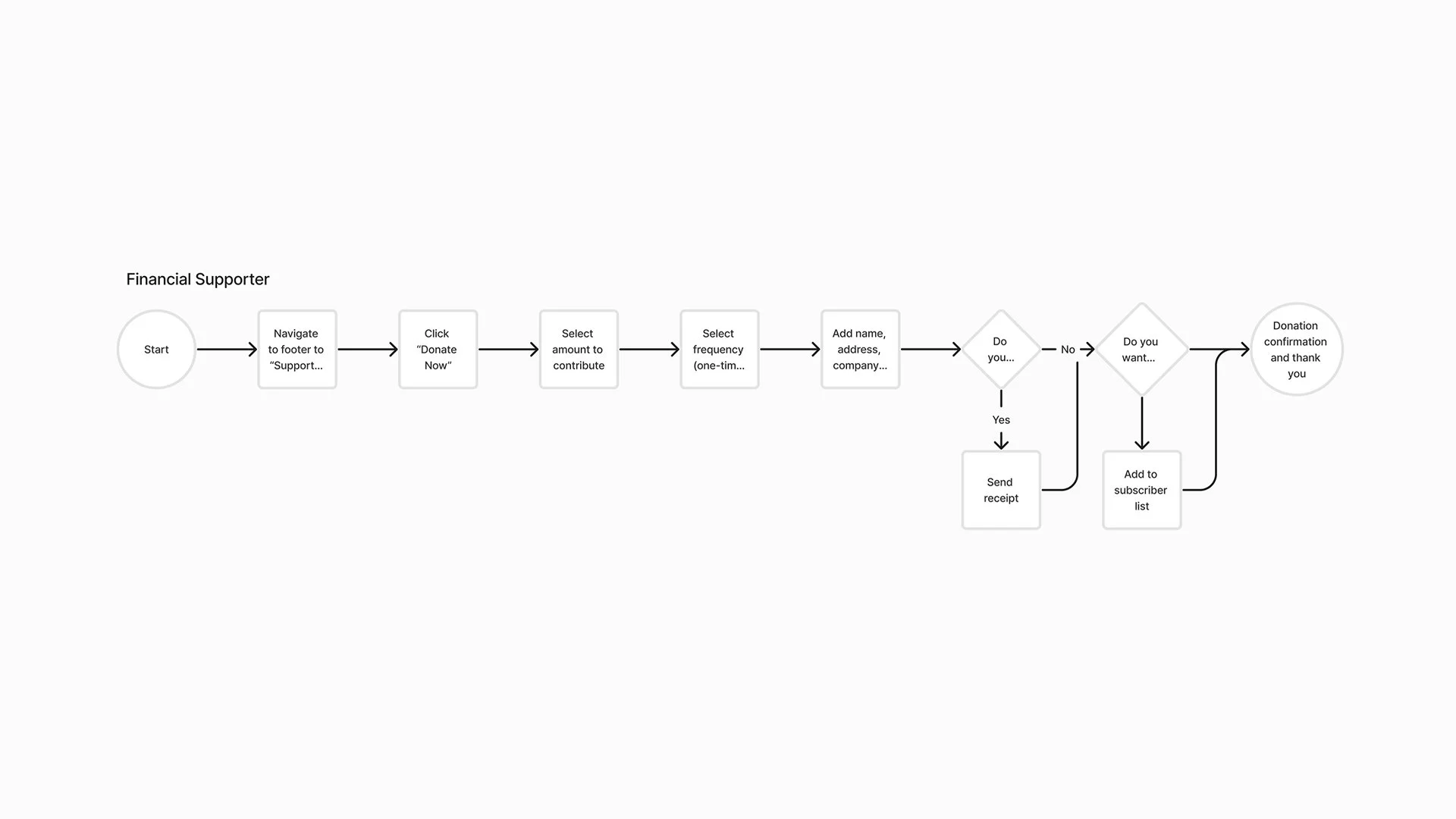
Supporter User Flow
Vendor and supporter pathways were fragmented, with hard-to-find forms, dead-end pages, and non-functioning elements that interrupted completion and feedback loops.
These were not cosmetic usability issues. They were structural weaknesses that required users to compensate for gaps in clarity and system logic, often by doing extra work, or abandoning the task entirely.
From Diagnosis to Action
ACTIONABILITY FOR A LIVE SYSTEM
Recommendations focused on changes that could improve clarity and flow without destabilizing an already-functioning marketplace. Rather than proposing wholesale redesign, guidance prioritized interventions that aligned with existing operations and could be implemented incrementally.
Clarifying audience priority at the page level, simplifying each page to a single dominant objective.
Standardizing templates and structural patterns to improve consistency without requiring platform changes.
Focusing on low-lift, high-impact fixes—such as clearer shipping language, more deliberate CTA placement, and consistent link behavior—before proposing deeper structural change.
DESIRABILITY
FEASIBILITY
VIABILITY
Evaluation lens used for recommendations
ACCESSIBILITY AS INFRASTRUCTURE
WCAG as Usability, Not Compliance
Accessibility work focused on basic readability and legibility, guided by WCAG 2.1 contrast standards—not as a compliance exercise, but as core usability.
On a content-heavy site like Prosperity Market, poor contrast, dense layouts, and hard-to-read text made simple tasks unnecessarily difficult. These issues didn’t block access outright, but they quietly increased effort and fatigue across shoppers, vendors, and supporters.
The work prioritized straightforward fixes—clearer typography, improved contrast, and more consistent visual hierarchy—treating accessibility as part of the system’s foundation, not an added feature.

ECONOMIC IMPACT
Unrealized Revenue as a Systems Problem
Rather than viewing low conversion as a marketing issue, the work treated unrealized revenue as a result of system friction.
Analytics showed steady traffic but significant drop-off between browsing, add-to-cart, and checkout. These losses aligned with unclear navigation, inconsistent patterns, and confusing checkout logic—not lack of interest or demand.
This reframed UX as an operational concern: improving clarity and flow wasn’t about visual refinement, but about removing obstacles that were already costing the organization money.
WHAT THIS WORK ENABLED
Value without Redesign
The outcome of the engagement was not a redesigned website, but clearer decision-making.
The work provided:
A structured audit showing where the site helped—or hindered—each user group
Shared language for discussing users, priorities, and tradeoffs
Practical guardrails for evaluating future changes against feasibility and risk
This gave the team a clearer basis for making incremental improvements, without forcing premature redesign decisions or overextending internal capacity.
Future Opportunities & Governance
Where Early Intervention Matters Most
This project surfaced a timing insight about where design and analysis are most effective.
The audit focused on the legacy site, even as a new version was already well underway. While the findings were accurate, they arrived after many structural decisions had already been made. In hindsight, applying the same evaluative lens to the in-progress build would have allowed issues to be identified earlier—before they were reintroduced and harder to unwind.
The takeaway was not about doing more work, but about intervening sooner. In live transition periods, comparative evaluation and early feedback create far more leverage than retrospective analysis, producing guidance teams can act on immediately rather than absorb abstractly.
A detailed walkthrough of the underlying research, page-level findings, supporting artifacts, and analytical framework is available in the full Case Study.